Over the past 12–18 months, voice AI has moved decisively from small pilots into live collections operations. What was once tested cautiously in limited segments is now being deployed across early-, mid-, and even late-stage delinquency flows.
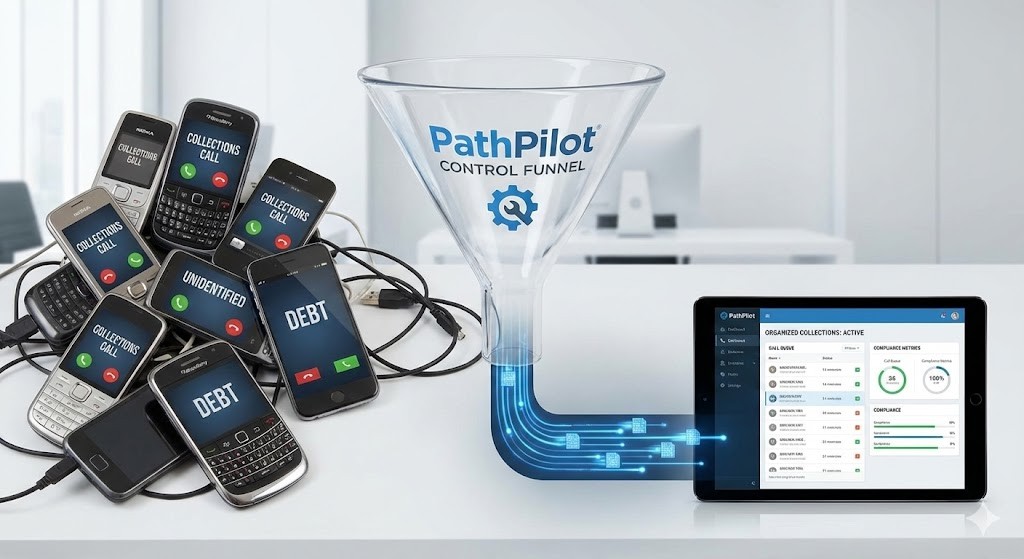
Collections teams are introducing outbound voice bots, AI-assisted dialing and call routing, and vendor-managed scripts that can change weekly without direct operator oversight. The promise behind this shift is compelling: increase contact volume, reduce cost per account, and accelerate recovery without adding headcount.
That promise is not theoretical. Public case studies show meaningful operational lift from voice automation in collections. For example, Concentrix reported a banking client generated $4.45M+ in direct promises-to-pay in the first month, handled 150,000 additional calls without adding advisors, and achieved a 7% improvement in resolution rates without human intervention after deploying a conversational voice bot for early-stage collections. TransUnion’s 2024 survey-based research also suggests the market is leaning in: the share of debt collectors investing in AI/ML grew from 11% (2023) to 18% (2024), with common use cases including payment-outcome prediction, segmentation, and self-service or virtual negotiations.
In other words, voice AI can outperform traditional capacity constraints and, in specific programs, deliver better throughput and comparable outcomes. The catch is that as performance scales, so does the blast radius of any compliance or privacy mistake.
However, voice is not just another automation channel layered onto collections. It is the most heavily regulated and highest-risk surface in the entire operation. As a result, it is also the place where governance gaps emerge first and with the greatest consequences.
What compliance leaders are seeing on the ground
For Heads of Compliance and Risk overseeing collections today, the environment has become increasingly noisy. Most receive multiple inbound pitches every week from vendors offering voice AI, predictive dialers, or so-called “compliance-ready” automation platforms. This is happening in parallel with higher account volumes: TransUnion found more than half of debt collection companies reported increased account volumes in the prior 12 months, which is one reason many are looking to automation to scale outreach. Nearly all of these tools claim FDCPA and TCPA compliance as a core feature.
Yet when compliance leaders probe deeper, very few vendors can clearly explain how compliance is continuously enforced across every call, in every jurisdiction, at scale. In many cases, compliance is reduced to static artifacts: a configurable script, an onboarding checklist, or contractual language that shifts responsibility without providing real control.
What is missing is provable, system-wide governance that allows compliance teams to understand not just what should happen, but what is actually happening across thousands or millions of calls.
Why voice AI creates disproportionate risk
Most voice AI tools govern only a narrow portion of the interaction lifecycle. They focus on what is said once a call begins and measure basic success indicators such as connection rates or call duration. These metrics may be useful for operational reporting, but they leave large risk surfaces unaddressed.
Voice AI systems typically do not govern whether a call should have happened in the first place, whether the timing was appropriate for the consumer’s jurisdiction, how errors propagate across repeated calls, or how downstream complaints and disputes relate back to automated behavior.
At the same time, voice vendors are economically incentivized to optimize for activity: minutes, connections, and conversations completed. They are not measured on regulatory exposure, audit defensibility, or cumulative compliance risk. This misalignment is not malicious; it is structural, and it leaves operators exposed.
Liability does not transfer to AI vendors
Industry bodies such as the Creditors Bar Association have been clear on a critical point: adopting AI does not reduce a creditor’s regulatory responsibility. Even when voice automation is outsourced to third-party vendors, liability for consumer protection, consent, and privacy remains with the creditor and the operator running the program.
Regulators do not evaluate intent or vendor assurances. They expect evidence. They expect organizations to demonstrate how compliance is enforced and how consumer data is protected in practice.
Voice AI amplifies these expectations because voice data is inherently sensitive. Recordings are stored, transcripts are generated and reused, and in some cases data is leveraged to improve models. In this environment, consent and disclosures cannot be assumed. They must be demonstrable. As voice automation scales, privacy and compliance exposure scale with it.
Why governance becomes mandatory
Once voice AI operates at machine speed, traditional safety mechanisms begin to fail. Sampling-based QA cannot keep pace with automated volume. Vendor assurances lose meaning when scripts and models change continuously. Static compliance documentation no longer reflects live system behavior.
At this point, governance stops being a back-office activity and becomes operational infrastructure. It is the layer that determines whether automation can be scaled safely or becomes a source of hidden risk.
What leading teams are doing now
Forward-looking collections leaders are adjusting their approach. Rather than accelerating deployment blindly, they are centralizing evaluation across all voice vendors, separating execution from quality and compliance oversight, and treating AI systems as auditable actors rather than simple tools.
The key shift is not technological but organizational. These teams are no longer asking how quickly they can deploy voice AI. Instead, they are asking how they can prove control before scaling further.
Call to action
If voice AI is part of your collections strategy, governance cannot be an afterthought.
Learn more about Collections Control → https://www.getpathpilot.com/compliance-risk-agent